
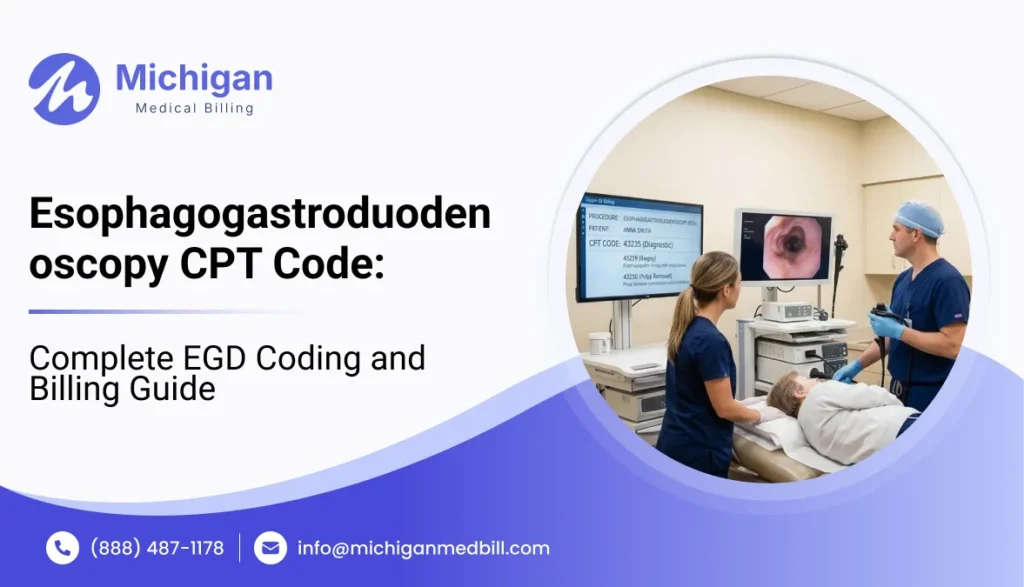
A routine EGD can turn into a very different coding situation in a matter of minutes. The gastroenterologist begins with a diagnostic examination, finds abnormal tissue, takes a biopsy, dilates a stricture, controls bleeding, or removes a foreign body. Each additional service can change the CPT code that belongs on the claim.
This is the exact reason why you can’t simply use CPT 43235 with the fact that it’s a diagnostic EGD to determine the proper Esophagogastroduodenoscopy CPT Code.
Coders must precisely identify: what services did the physician assess, the diagnostic findings from the assessment, the procedure which was utilized, and the course of therapy, if and to what extent it was carried out. In doing so they will have to consider: bundling edits, modifiers, medical necessity, diagnostic coding and payer guidelines.
We will address some of the most used EGD codes in our EGD (esophagogastroduodenoscopy) CPT code guide, including: diagnostic EGD, biopsy, dilatation, hemostasis, foreign body removal, modifiers, documentation and typical EGD billing issues.
For practices handling a high volume of endoscopy claims, accurate medical coding services can also help keep procedure codes, diagnoses, modifiers, and documentation aligned before claims reach the payer.
What Is Esophagogastroduodenoscopy?
Esophagogastroduodenoscopy, better known as EGD or upper GI endoscopy, is a procedure used to examine the upper gastrointestinal tract.
A flexible endoscope is passed through the patient’s mouth so the physician can view the:
- Esophagus
- Gastroesophageal junction
- Stomach
- Pylorus
- Duodenum
An EGD may be completely diagnostic. In other cases, the physician performs one or more therapeutic procedures during the same session.
For example, an EGD may involve:
- Biopsy of abnormal tissue
- Treatment of gastrointestinal bleeding
- Esophageal dilation
- Gastric or duodenal dilation
- Foreign body removal
- Variceal treatment
- Lesion removal
- Endoscopic ultrasound
- Feeding tube placement
- Stent placement
- Ablation
The proper Esophagogastroduodenoscopy CPT code thus actually is determined not simply by a physician’s advance reservation but by what in fact occurred in the encounter.
What Is the Main Esophagogastroduodenoscopy CPT Code?
For a diagnostic EGD, the most commonly recognized code is CPT 43235.
The use of a flexible EGD (transoral) with brushing or washings when the brushing or washings were taken for diagnostic is code 43235.
However, 43235 should not become the automatic code for every upper GI endoscopy.
When a biopsy, dilation, the control of a bleed, lesion removal, or a procedure with another intent is done by a doctor; there generally is another more appropriate code that describes the completed service.
CMS’s 2026 NCCI Policy Manual makes an important distinction: a surgical endoscopy includes the diagnostic endoscopy. Therefore, the diagnostic endoscopy code generally should not also be reported when a more extensive surgical endoscopy code describes the procedure performed.
This rule is central to EGD billing because the physician almost always performs some degree of diagnostic examination before reaching the point where treatment is needed.
Common EGD CPT Codes at a Glance
Common Esophagogastroduodenoscopy CPT Codes
Choose the CPT code based on the procedure actually performed, not only the scheduled EGD.
The table below provides a practical overview of commonly encountered EGD codes. Descriptions are summarized rather than copied from the official CPT codebook.
| CPT Code | Common Procedure |
| 43233 | EGD with large-balloon esophageal dilation |
| 43235 | Diagnostic EGD |
| 43236 | EGD with directed submucosal injection |
| 43237 | Limited endoscopic ultrasound examination |
| 43238 | Limited EUS-guided needle aspiration or biopsy |
| 43239 | EGD with biopsy |
| 43240 | EGD with transmural drainage |
| 43241 | EGD with intraluminal tube or catheter placement |
| 43242 | EUS-guided needle aspiration or biopsy with more complete examination |
| 43243 | Injection treatment of esophageal or gastric varices |
| 43244 | Variceal band ligation |
| 43245 | Dilation of gastric or duodenal stricture |
| 43246 | Percutaneous gastrostomy tube placement |
| 43247 | Foreign body removal |
| 43248 | Esophageal dilation over a guidewire |
| 43249 | Transendoscopic esophageal balloon dilation |
| 43250 | Lesion removal using hot biopsy forceps |
| 43251 | Lesion removal using snare technique |
| 43252 | Optical endomicroscopy |
| 43253 | EUS-guided transmural injection |
| 43254 | Endoscopic mucosal resection |
| 43255 | Endoscopic control of bleeding |
| 43257 | Delivery of thermal energy for certain GERD treatments |
| 43259 | EGD with more complete endoscopic ultrasound examination |
| 43266 | Endoscopic stent placement |
| 43270 | Endoscopic lesion ablation |
ASGE coding resources distinguish diagnostic EGD, biopsy, ultrasound, injection, dilation, lesion treatment, bleeding control, and other interventions within the 43235 family and related codes.
Always use the current AMA CPT code set for the exact descriptor and applicable instructions for the date of service.
CPT 43235 vs. CPT 43239: Diagnostic EGD or Biopsy?
This is one of the most common coding questions in gastroenterology.
CPT 43235 vs. CPT 43239
The key difference is whether a tissue biopsy was performed during the EGD.
Used when the physician performs a diagnostic upper GI endoscopy without a separately reportable therapeutic intervention.
Typical Example
EGD is completed without biopsy, dilation, lesion removal or bleeding control.
Used when tissue is obtained through biopsy during the upper GI endoscopy.
Typical Example
Abnormal gastric tissue is identified and specimens are collected with biopsy forceps.
Do not automatically report both codes.
When biopsy is performed during the same EGD session, the diagnostic examination is generally included in the more comprehensive procedure.
CPT 43235
Use 43235 when the physician performs a diagnostic EGD without a separately reportable therapeutic procedure.
Brushing and washing, when performed as part of the diagnostic examination, are included.
CPT 43239
CPT 43239 applies when the physician obtains tissue through biopsy during the EGD.
Suppose a patient undergoes an EGD for persistent upper abdominal symptoms. The physician identifies suspicious gastric mucosa and takes several tissue samples.
The procedure is no longer simply a diagnostic EGD.
In that setting, 43239 would typically describe the biopsy procedure itself, while 43235 would not usually be reported separately for the diagnostic component.
According to the CMS, diagnostic endoscopy is considered part of Surgical Endoscopy and in general should not be separately reported if the provider previously inspected the area and then intervened.
Does the Number of Biopsies Change the Code?
Taking several biopsies does not automatically mean 43239 should be billed several times.
A biopsy taken as part of a procedure will be captured in the code. We will still expect the medical record to note where the biopsy samples were taken, and why there was need for an biopsy to be performed.
Clean documentation makes accurate medical billing services easier because the billing team does not have to reconstruct the procedure from vague notes.
EGD With Dilation: Which CPT Code Should You Use?
Dilation is an area where seemingly small documentation details can completely change code selection.
A coder should identify two things first:
- What anatomical structure was dilated?
- What dilation technique did the physician use?
CPT 43248: Guidewire Dilation
CPT 43248 is commonly associated with esophageal dilation when dilators are passed over a guidewire.
The procedure report should clearly describe the guidewire technique.
CPT 43249: Esophageal Balloon Dilation
CPT 43249 generally applies to certain transendoscopic balloon dilation procedures involving the esophagus.
Documentation should identify the type of dilation and provide relevant procedural detail.
CPT 43233: Large-Balloon Esophageal Dilation
For CPT 43233, providers use a balloon that meets the code’s specified size requirements to dilate the esophagus. This code also applies to certain procedures that treat achalasia.
CPT 43245: Gastric or Duodenal Dilation
Not every upper-GI dilation involves the esophagus.
When a gastric or duodenal stricture is dilated endoscopically, CPT 43245 may be the appropriate coding consideration.
The easiest mistake is to see the phrase “EGD with dilation” and select a code before reading the full operative report.
Good coding requires the anatomy and technique, not just the procedure title.
Choose the CPT Code by Anatomy and Technique
“EGD with dilation” alone is not enough. Check what was dilated and which technique the physician used.
1. Identify Anatomy
Esophagus, stomach or duodenum?
2. Identify Technique
Guidewire, balloon or another method?
3. Verify the Code
Check CPT definitions, NCCI edits and payer rules.
CPT 43255 for EGD With Control of Bleeding
CPT 43255 is commonly used when a physician performs endoscopic treatment to control non-variceal gastrointestinal bleeding during an EGD.
The exact technique may vary based on the lesion and clinical situation.
What matters for coding is that the record supports an actual bleeding-control intervention.
Simply documenting that a lesion had previously bled or that blood was seen does not, by itself, establish that an endoscopic bleeding-control procedure was performed.
Another important distinction involves varices.
Specific CPT codes exist for certain variceal treatments:
- 43243 for injection treatment in applicable circumstances
- 43244 for band ligation
Using a general bleeding-control code when a more specific procedure was performed can lead to coding problems.
Diagnosis coding is equally important. For example, practices reviewing claims involving rectal or gastrointestinal bleeding may also find our guide to the ICD-10 Code for Hematochezia useful when working through documentation and diagnosis-code selection.
CPT 43247 for Foreign Body Removal
CPT 43247 is commonly associated with endoscopic removal of a foreign body from the upper gastrointestinal tract.
A typical situation may involve an impacted food bolus in the esophagus.
The procedure note should make the story clear:
- What was found?
- Where was it located?
- How was it removed?
- Was removal complete?
- Were other procedures performed?
These details become especially important if the physician also treats bleeding, performs dilation, or completes another intervention during the same session.
Multiple documented actions do not automatically mean every action can be separately billed.
How EGD Bundling Rules Affect Claims
Endoscopy claims are a common place for unbundling mistakes.
For current bundling and correct coding guidance, practices should review the CMS NCCI Policy Manual before reporting multiple endoscopic services during the same encounter.
CMS instructs providers to report the code that describes the procedure with the greatest available specificity and not to submit several codes when one comprehensive code adequately describes the work performed.
CMS also states that when several endoscopic services are performed, the most comprehensive appropriate code should be reported. More than one code may be reported when separate medically necessary services are not adequately described by one code, subject to coding rules and edits.
Before billing multiple EGD procedures, check:
- Whether one service is included in another
- Current NCCI procedure-to-procedure edits
- Whether the procedures occurred at separate sites
- Whether a modifier is permitted
- Whether the documentation supports separate services
- Payer-specific requirements
Adding modifier 59 simply because two codes will not process together is not a safe billing strategy.
The record must support why the services are distinct.
When claims are already rejecting because of bundling, modifier, or coding problems, structured denial management services can help identify whether the problem started with coding, documentation, eligibility, authorization, or payer processing.
Modifiers That May Affect EGD Billing
Modifiers explain circumstances that the CPT code itself does not fully communicate.
They are not automatic additions to an EGD claim.
Modifier 52
Modifier 52 may be considered when a service is reduced under circumstances that support reduced-service reporting.
The documentation should explain what portion of the expected procedure was not completed and why.
Modifier 53
Modifier 53 may apply to physician reporting when a procedure is started but discontinued because continuing it could affect the patient’s well-being or because circumstances prevent safe completion.
Modifiers 73 and 74
These modifiers are generally relevant to qualifying facility claims rather than professional physician billing.
Modifier 73 addresses certain procedures discontinued before anesthesia administration, while modifier 74 addresses applicable procedures discontinued after anesthesia or after the procedure has begun.
Modifier 59 and X Modifiers
Providers may use modifier 59 or an appropriate X modifier to identify a truly distinct procedural service when coding rules allow separate reporting.
The key word is distinct.
Do not use a modifier simply to overcome an NCCI edit. The clinical circumstances and documentation must justify separate billing.
Can an E/M Visit Be Billed With an EGD?
Sometimes, but not simply because the physician spoke with the patient before the procedure.
CMS explains that work inherent to a procedure is not separately billable as an E/M service. A significant and separately identifiable E/M service may be reported in appropriate circumstances when the documentation supports it.
This is where documentation becomes especially important.
The documentation must specify the E/M code performed separately was greater than a typical evaluation and service that is part of an endoscopy procedure.
Practices that frequently bill office visits alongside procedures may also want to review our CPT Code 99214 billing guide for a deeper look at documentation, medical decision-making, and established-patient E/M coding.
Diagnosis Coding and Medical Necessity for EGD
A correctly assigned CPT code could still be denied, if the diagnosis does not medically justify the procedure performed.
ICD-10-CM code must be in accordance with the condition, symptom or finding found in the treating provider documentation.
Depending on the case, an EGD may be performed to evaluate conditions involving:
- Dysphagia
- Upper GI bleeding
- Persistent vomiting
- Anemia
- Reflux-related symptoms
- Suspected ulcers
- Esophageal abnormalities
- Gastric lesions
- Varices
- Other documented upper-GI conditions
Do not choose a diagnosis simply because it appears on a payer’s coverage list.
The diagnosis must reflect the patient’s actual medical record.
Patients with GI symptoms may initially be evaluated in family practice billing or urgent care billing environments before referral for specialist evaluation or endoscopy. Regardless of where the care journey starts, each provider’s claim should represent the service that provider actually performed and documented.
Documentation Checklist for EGD Coding
A strong EGD note should allow a coder to understand the procedure without guessing.
Before final code selection, confirm that the documentation identifies:
- Clinical indication
- Extent of the examination
- Anatomical structures examined
- Procedure findings
- Biopsy site
- Method of tissue or lesion removal
- Dilation location
- Dilation technique
- Balloon size when relevant
- Bleeding-control technique
- Foreign body location and removal method
- Variceal treatment
- EUS service when performed
- Stent or tube placement
- Whether the procedure was completed
- Reason for discontinuation when applicable
- Complications
The scheduled procedure should never replace the final procedure note for coding purposes.
If the order says “diagnostic EGD” but the physician takes a biopsy, final coding should reflect the documented completed service.
Common EGD Billing Errors That Lead to Denials
Billing 43235 With Every EGD
Cpt 43235 isn’t some of every upper scope; it actually has one that would include the other component.
Choosing the Wrong Dilation Code
Services such as dilatation Esophageal guidewire are different from esophageal balloon dilatation and the gastric or duodenal dilatations.
Coding From the Scheduled Procedure
The plan and the completed procedure can differ significantly.
Always use the final procedure documentation.
Incorrect Modifier Use
A modifier cannot repair a claim when the underlying services are actually bundled.
Weak Diagnosis Support
The diagnosis should demonstrate the clinical reason for the EGD based on provider documentation and payer requirements.
Using a General Bleeding Code for Variceal Treatment
More specific codes exist for certain variceal interventions.
Billing Every Technique Separately
The procedure note may describe several steps that a comprehensive CPT service already includes.
Missing Payer Requirements
Each commercial payer, including Medicare, Medicaid plan and other insurer will apply their specific rules with respect to authorization, medical necessity, claim submission.
Common EGD Billing Errors That Trigger Denials
Many avoidable EGD denials begin before the claim reaches the payer. Review these areas before submission.
01 — Billing 43235 With Every EGD
Diagnostic EGD is generally included when a more comprehensive therapeutic procedure is performed.
02 — Wrong Dilation Code
The anatomy and dilation technique must match the selected CPT code.
03 — Coding From the Schedule
Final coding should follow the completed procedure note instead of the planned procedure.
04 — Unsupported Modifier Use
A modifier should explain a valid coding circumstance, not simply bypass a payer edit.
05 — Weak Medical Necessity
Diagnosis coding should reflect the documented clinical reason for the procedure.
06 — Separately Billing Bundled Work
Some steps described in the procedure note may already be included in the comprehensive CPT service.
Before the EGD claim goes out, verify:
✓ Procedure Performed✓ Anatomy & Technique✓ NCCI Edits✓ Modifier Support✓ Diagnosis Linkage✓ Payer Policy
Practical EGD Coding Examples
Scenario 1: Diagnostic EGD Only
A physician examines the esophagus, stomach, and duodenum. The provider does not perform a biopsy or any other therapeutic intervention.
Possible CPT: 43235.
Scenario 2: EGD With Gastric Biopsy
The provider identifies abnormal gastric tissue and obtains biopsy specimens.
Possible CPT: 43239.
Providers generally do not report the diagnostic examination separately.
Scenario 3: Esophageal Guidewire Dilation
The physician performs EGD and dilates an esophageal narrowing using a guidewire technique.
Possible CPT: 43248.
Scenario 4: Foreign Body Removal
The provider identifies an impacted food bolus in the esophagus and removes it endoscopically.
Possible CPT: 43247.
Scenario 5: Variceal Banding
The provider identifies esophageal varices and treats them with band ligation.
Possible CPT: 43244.
Scenario 6: Endoscopic Bleeding Control
The provider identifies a non-variceal bleeding lesion and treats it endoscopically.
Possible CPT: 43255 when the documented service meets applicable coding requirements.
Final coding always depends on the complete procedure note, current CPT guidance, NCCI edits, payer rules, and all services performed during the encounter.
Why Accurate EGD Coding Matters to the Revenue Cycle
An EGD claim does not exist in isolation.
Medical coding directly affects claim generation, payer edits, reimbursement, denial follow-up, accounts receivable, and compliance.
One incorrect CPT code can create work for several people later.
Common consequences include:
- Claim rejection
- Payment delay
- Medical-record requests
- Underpayment
- Overpayment
- Recoupment risk
- Coding rework
- Avoidable appeals
This is why strong revenue cycle management services connect coding accuracy with eligibility, claim submission, payment posting, denial follow-up, and reporting instead of treating each step as a separate problem.
For Michigan practices looking for support across the complete process, Michigan Med Bill provides billing, coding, denial management, credentialing, insurance verification, physician billing, and RCM support for medical practices. The goal should never be to report the highest-paying EGD code. The goal is to submit the code that most accurately reflects the documented service.
Final Thoughts
The best way to choose the correct Esophagogastroduodenoscopy CPT Code is to stop thinking of EGD as a single procedure code.
Start with what actually happened.
Was the procedure diagnostic? Did the provider remove any tissue? Was the esophagus dilated during the procedure? Did the provider treat any bleeding? Was variceal banding performed? Did the provider remove a foreign body?
Then match the documented work to the most specific current CPT code and check bundling, modifier, diagnosis, and payer requirements before submission.
CMS’s 2026 NCCI guidance requires accurate, specific coding and states that providers should not report a diagnostic endoscopy separately when they perform a more extensive surgical endoscopy during the same session.
A careful review before claim submission is usually much easier than correcting a denial several weeks later. For practices that need help managing that process consistently, Michigan Med Bill’s medical billing and coding solutions can support cleaner claims from coding through final reimbursement.
Frequently Asked Questions About Esophagogastroduodenoscopy CPT Codes
What is the CPT code for a diagnostic EGD?
Providers use CPT 43235 for a diagnostic flexible transoral EGD when they do not perform a separately reportable therapeutic intervention.
What is the CPT code for EGD with biopsy?
CPT 43239 applies when a provider performs a tissue biopsy during an EGD.
Can Providers Bill CPT 43235 and 43239 Together?
Generally, no. When the provider performs a biopsy during the same session, CPT 43239 includes the diagnostic examination represented by CPT 43235. However, always check the current payer policies and NCCI rules before billing.
Which CPT Code Should Providers Use for EGD With Dilation?
It depends on the anatomy and technique. Common examples include 43248, 43249, 43233, and 43245. The operative report should determine the final selection.
When Should Providers Use CPT 43255?
CPT 43255 applies to EGD procedures that use endoscopic techniques to control bleeding. Specific procedures such as variceal treatment may require a different code.
Can Providers Bill an EGD and an Office Visit on the Same Day?
You may sometimes report a separately identifiable E/M service when the documentation and applicable coding rules support it.. Routine pre-procedure work is not automatically a separately billable office visit.
Why are EGD claims denied?
Frequent causes include wrong CPT selection, unbundling, unsupported modifiers, insufficient medical necessity, incomplete documentation, diagnosis mismatches, and payer-specific requirements.