
Urgent Care CPT Codes: Complete Guide to Coding and Billing for Urgent Care Services
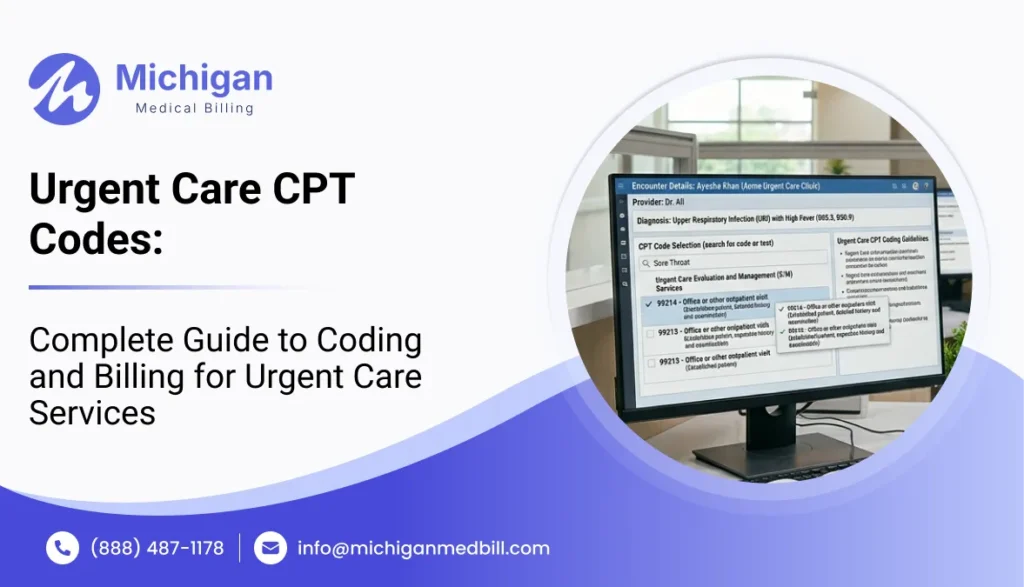
Urgent care centers play an important role in the U.S. healthcare system by providing fast medical attention for conditions that require immediate treatment but do not always require an emergency room visit. From respiratory infections and minor injuries to diagnostic testing and urgent medical procedures, these facilities manage a wide range of patient needs every day. How accurate CPT codes can support revenue & compliance in urgent care One of the key components to a successful urgent care appointment is how well medical codes are applied. CPT codes at an urgent care office help your payers understand exactly what services you provided to your patients. With accurate medical codes you’ll see improved reimbursement, maintain compliance and avoid denied claims. Urgent care billing, though, is far from straightforward to just pick from a list of CPTs. They need to consider the patient’s condition, level of documentation, medical decision-making, procedures involved and requirements of the specific insurer. Incorrect coding can result in: Claim denials Underpayments Compliance issues Delayed reimbursements Increased administrative workload Let Smart Michigan medical billing companies provide your urgent care service with increased coding accuracy, efficiency and a strong revenue cycle. Includes most used codes by urgent care centers in CPT, Coding regulations, Documentation requirements, Commonly made mistakes and Tips to improve your billing process. From Patient Visit to Clean Claim A successful healthcare billing process connects clinical care, accurate documentation, coding decisions, and insurance processing. 01 Patient Assessment 02 Clinical Documentation 03 Code Selection 04 Claim Processing What Are Urgent Care CPT Codes? CPT refers to Current Procedural Terminology, a set of standard codes that describe services and procedures performed by health care providers, originally created by the AMA. In urgent care billing, CPT codes identify the services provided during a patient visit, including: Patient evaluations Diagnostic tests Minor procedures Imaging services Medication administration Preventive services Insurance companies use CPT codes along with diagnosis codes and other claim information to determine reimbursement. Healthcare organizations should follow updated CPT and HCPCS code guidelines from official CMS resources to maintain accurate claim reporting and compliance. For example, if a patient visits an urgent care center for a sore throat, the claim may include: A CPT code for the office visit A CPT code for a rapid strep test An ICD-10 diagnosis code describing the condition These codes work together to explain why the patient received care and what services were provided. Difference Between CPT, ICD-10, and HCPCS Codes Just because they all look “kind of the same” on a medical claim, CPT codes, ICD-10 codes and HCPCS codes can be confusing to even health care providers! Each one plays a unique role. CPT Codes CPT codes describe: Procedures Medical services Provider activities Examples: Office visits Laboratory testing Imaging Procedures ICD-10-CM Codes ICD-10 codes explain: Diseases Symptoms Medical conditions Diagnoses Providers should also review current ICD-10-CM coding guidelines to ensure diagnosis information is reported correctly on healthcare claims. Examples: Influenza Hypertension Ear infection Laceration HCPCS Codes HCPCS codes are commonly used for: Supplies Certain medications Medical equipment Additional healthcare services Understanding the difference between these coding systems is essential for accurate urgent care claims. Why Accurate Urgent Care CPT Coding Matters Urgent care practices often see high patient volumes, which means even small coding errors can create significant financial problems. 1. Improves Reimbursement Accuracy Accurate coding of the services is to ensure the providers receive reimbursement for work rendered. A comprehensive history and physical with significant medical decision-making will be a higher level code versus a lower level that providers would be making less on a complex visit coded as a simple visit. At the same time, selecting a higher-level code without proper documentation can create compliance risks. The goal is accurate coding that reflects the actual complexity of care provided. 2. Reduces Claim Denials Insurance companies review claims carefully to ensure submitted services match medical documentation. Common reasons urgent care claims are denied include: Incorrect CPT code selection Missing documentation Invalid modifiers Lack of medical necessity Coding inconsistencies A strong denial prevention process, combined with proper coding practices, can significantly improve payment collection. Practices can also learn effective strategies through our guide on how to reduce claim denials and improve their revenue cycle performance. Healthcare organizations looking to improve their denial rates can also benefit from reviewing strategies around how to reduce claim denials and implementing stronger billing workflows. 3. Maintains Compliance Healthcare coding errors can lead to audits, repayment requests, and compliance concerns. Urgent care providers must ensure: Documentation supports billed services CPT codes match performed procedures Modifiers are applied correctly Coding follows payer requirements Code to current practice is especially crucial because CPT coding guidelines are frequently updated. Today’s current E/M coding focuses on medical decision making or total time, not the history and physical. Most Common Urgent Care CPT Codes We’re taking a look at all the different types of Evaluation Codes, procedure codes, laboratory codes and diagnostic service codes a patient might encounter at an urgent care clinic. Below are some commonly used CPT codes for urgent care visits. CPT Code Description Common Usage 99202 New patient office visit Straightforward new patient evaluation 99203 New patient office visit Low-complexity patient assessment 99204 New patient office visit Moderate-complexity evaluation 99205 New patient office visit High-complexity evaluation 99212 Established patient visit Minor follow-up care 99213 Established patient visit Common urgent care illness visits 99214 Established patient visit Moderate-complexity established visits 99215 Established patient visit High-complexity established visits 87880 Rapid strep testing Diagnosing throat infections 87426 COVID antigen testing Respiratory illness testing 87635 COVID molecular testing Laboratory diagnosis 93000 Electrocardiogram Cardiac-related evaluations 71046 Chest X-ray Respiratory complaints 96372 Injection administration IM medication injections 12001-12021 Wound repair Cuts and minor injuries Understanding E/M Codes in Urgent Care Billing Evaluation and Management (E/M) codes represent some of the most frequently billed services in urgent care settings. Urgent care providers typically report office or outpatient E/M codes ranging from 99202-99205 for new patients and 99211-99215 for established patients. Selecting the correct E/M